
How to Choose a Concrete Batching Plant for High-Temperature Climates in the Middle East?
A complete engineering guide on choosing and modifying a concrete batching plant for extreme 45°C+ heat in Saudi Arabia, UAE, and the Middle East to prevent slump loss and project rejection

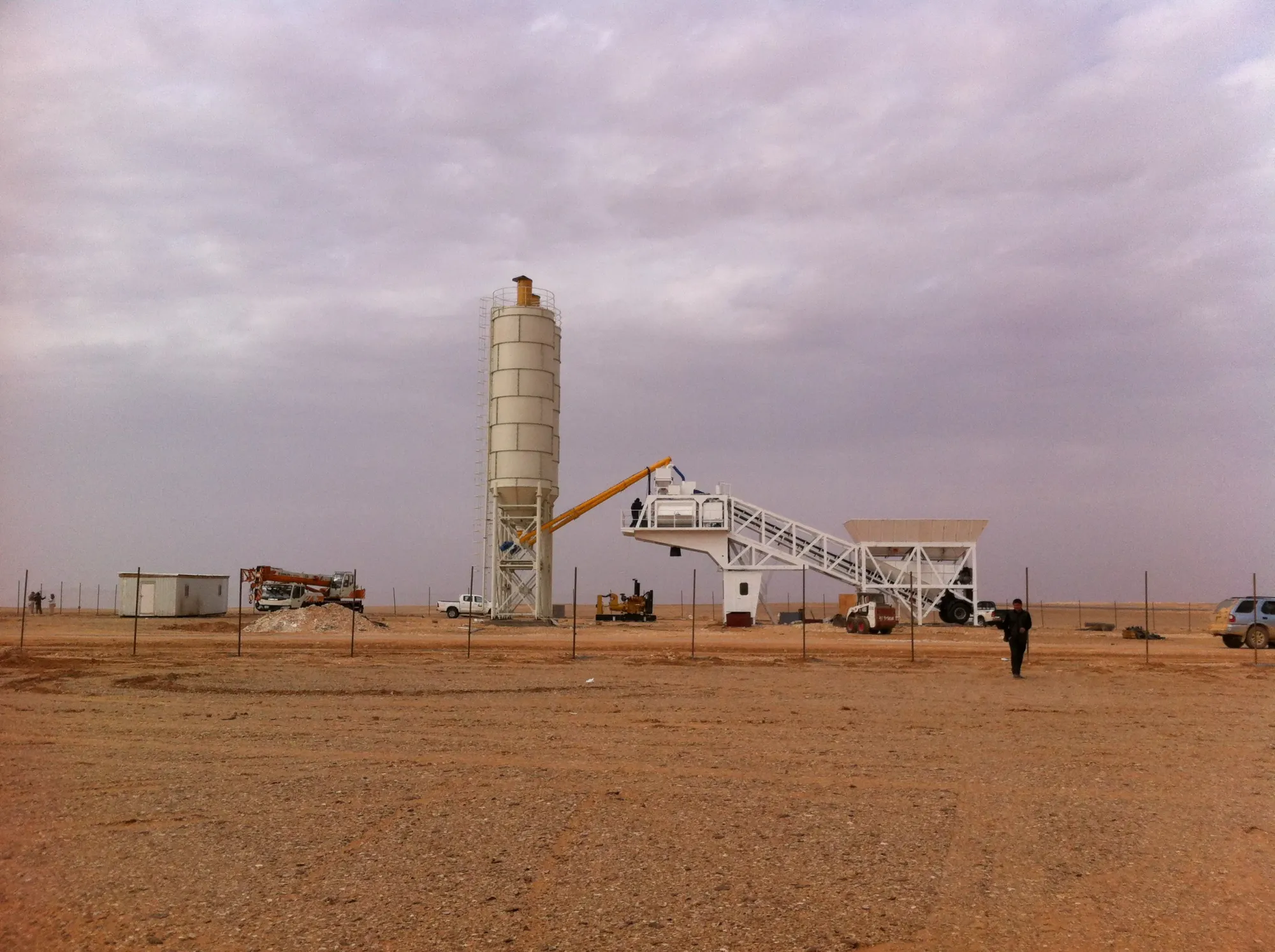
Introduction: Why Hot Climate Changes Everything
Concrete production in the Middle East (Saudi Arabia, UAE, Qatar, Oman, and Kuwait) is fundamentally different from temperate regions. Ambient temperatures routinely exceed 45°C, and the surface temperatures of exposed aggregates can skyrocket past 60°C.
Under these extreme conditions, standard plant configurations fail. High thermal stress accelerates cement hydration exponentially, causing severe technical risks:
- Flash Slump Loss: Rapid loss of workability during transit.
- Uncontrolled Hydration: Premature setting and micro-cracking inside transit mixers.
- Compressive Strength Degradation: Lower long-term structural integrity.
- High Site Rejection Rates: Costly batch rejections by strict project consultants (e.g., Saudi Aramco or ADNOC standards).
Selecting a concrete batching plant for desert environments is not a mere procurement decision—it is a thermal engineering design. This guide explains exactly how to configure a system engineered for ultimate heat resistance, dust control, and stable consistency under extreme conditions.
1. Key Engineering Challenge: Heat vs. Concrete Performance
Concrete performance is highly sensitive to raw material temperatures. To comply with international standards (such as ACI or ASTM) used in the Middle East, fresh concrete must typically be discharged at a temperature below 30°C or 32°C.
Because aggregates make up over 70% of the concrete mass, they act as the primary heat reservoir. When ambient heat is combined with the mechanical friction heat generated inside the mixer, achieving the target discharge temperature requires precise multi-system cooling and thermodynamic management.
2. Advanced Technical Configuration: Hot-Climate Optimized vs. Standard Plant
To survive the desert heat, every system within the batching plant must be engineered for thermal isolation and proactive refrigeration.
Aggregate Cooling & Storage System
- Standard Plant: Open-air bins with raw material exposure.
- Hot-Climate Optimized: Fully enclosed, thermally insulated inline batching bins. Equipped with automated micro-atomization water misting systems at the top and chilled air injection loops at the bottom to counter ground heat radiation.
Mixing Host & Discharge System
- Standard Plant: Basic single-shaft or light-duty twin-shaft mixer.
- Hot-Climate Optimized: Heavy-duty, high-shear twin-shaft mixer (e.g., BHS-type design) equipped with high-temperature-resistant fluoro-rubber seals, heavy-duty wear-liners, and an automated large-diameter pneumatic air-relief venting system to dissipate internal air friction heat.
Water & Ice Refrigeration System
- Standard Plant: Ambient water piping.
- Hot-Climate Optimized: Heavy-duty containerized water chillers supplying water at $\le$ 4°C, paired with an integrated Flake Ice Handling System featuring insulated automatic rake storage and double-screw delivery.
Cement & Powder Storage
- Standard Plant: Standard raw steel silos.
- Hot-Climate Optimized: Silos coated with high-vacuum ceramic bead thermal-reflective paint (reflectivity $\ge$ 85%), dual pneumatic heavy-duty pressure relief valves to prevent blowouts during hot pneumatic filling, and base-mounted resistance thermometers.
Automation & Electrical Control
- Standard Plant: Basic PLC in a standard ventilated cabinet.
- Hot-Climate Optimized: Industrial-grade PLC housed in a dust-proof enclosure equipped with an independent, anti-vibration climate-control air conditioner. The control software features high-frequency microwave moisture sensors and dynamic ice/water ratio locking algorithms.
3. Step-by-Step Selection & Engineering Strategy
Step 1: Define Thermal Mass Over Hourly Output
Do not calculate capacity solely in $m^3/\text{hour}$. You must calculate the plant based on its cooling capacity per cubic meter. Ensure the water chilling plant and flake ice generators can keep up with the peak hourly output under 45°C+ ambient conditions.
Step 2: Choose a High-Shear, Fast-Discharge Twin-Shaft Mixer
In desert climates, your mixing strategy must be high-frequency, ultra-short, and highly constant.
- Keep the mixing cycle locked between 60 to 75 seconds. High shear intensity achieves homogeneity faster.
- Ensure the discharge gate is oversized and pneumatically driven to empty the mixer within 10 to 15 seconds. Minimizing the time concrete spends inside the mixer prevents excess heat accumulation from mechanical friction.
Step 3: Implement Ground Heat Isolation for Aggregates
Do not rely solely on top-shading. Install 20mm high-density epoxy thermal isolation gaskets between the batching station foundations and the steel structure of the aggregate bins. This cuts off the immense conductive heat radiating from the parched desert ground into the lowermost aggregates.
Step 4: Protect Powder Materials from Silo Heat Traps
Sun-baked steel silos can heat cement to over 70°C, causing instant slump loss upon contact with water. Ensure your silos are painted white with solar-reflective coatings and monitor base temperatures continuously.
Step 5: Secure the Automation Environment
Electronics fail rapidly above 50°C. Never purchase a plant that relies on simple cooling fans for the main electrical cabinet. An independent cabinet air conditioner is mandatory to ensure the PLC can process real-time batching corrections without overheating.
4. Crucial Implementation Details for Field Operations
To ensure operational profitability and pass rigorous site inspections, two highly overlooked system designs must be integrated into your plant layout:
A. Flake Ice Transport and Anti-Caking Delivery (Flake Ice Handling System)
When cold water is insufficient to lower concrete temperatures below 30°C, flake ice must replace a portion of the batching water, leveraging ice’s latent heat of fusion ($\lambda = 334 \text{ kJ/kg}$). However, flake ice easily melts, clumps, and jams pneumatic valves in high heat.
- Automatic Rake Storage: The ice must be stored in a containerized ice room equipped with mechanical rakes operating between -5°C and -2°C to prevent caking.
- Insulated Double-Screw Conveyors: Ice must be transported via heavy-duty, polyurethane-insulated twin screw conveyors at an incline under 25° to prevent slippage and clumping.
- "Water-First, Ice-Second" Batching Sequence: The PLC should inject 50% of the chilled water first to lubricate the mixer shaft, followed immediately by the flake ice synchronized with the aggregates. The colliding aggregates crush any remaining ice fragments, ensuring 100% melting before discharge. No ice crystals are permitted in the fresh mix.
B. Bottom-Up Chilled Air Injection for Aggregate Bins
While top-mist spraying cools the surface, water tends to accumulate at the bottom of the aggregate bin, creating an "uneven moisture gradient" (wet at the bottom, dry at the top). This blinds moisture sensors and ruins the water-cement ratio.
- Counter-Current Cooling: Install a perimeter ring of chilled-air induction pipes with anti-clogging shields right above the discharge gates of the aggregate bins.
- Fluidized Dehumidification: Continuously blow dry, chilled air (5°C to 10°C) upward through the aggregates. The air extracts core heat via convection and evaporates stagnant water accumulation at the bottom, maintaining uniform aggregate moisture and a predictable water-cement ratio.
5. Summary: Core Differences Matrix
| Technical Metric | Standard Plant Design | Hot-Climate Engineered Plant (Middle East Standard) |
| Aggregate Cooling | Open bins; basic shade; passive top-water spraying. | Fully enclosed insulated bins + Base Gasket Heat-Isolators + Bottom Chilled-Air Injection. |
| Mixer Insulation | Standard twin-shaft; prone to high friction heat retention. | Heavy-duty twin-shaft + Fluoro-rubber high-temp seals + Oversized Pneumatic Air-Relief Venting Valve. |
| Refrigeration Integration | Ambient water supply or external hook-up water tank. | Containerized Water Chiller ($\le$4°C) + Sub-Zero Rake Ice Room + Insulated Screw Conveyor. |
| Silo Safety | Basic industrial paint; standard pressure relief. | High-Vacuum Ceramic Reflective Paint ($\ge$85%) + Heavy-Duty Multi-Pneumatic Pressure Valves. |
| Control Cabinets | Ambient air cooling fans (susceptible to dust/heat trips). | Dust-Proof Enclosure with Integrated Anti-Vibration Cabinet Air Conditioner. |
| PLC Control Logic | Manual moisture adjustments; fixed water values. | Dynamic Ice/Water Ratio Balancing Algorithm + 1GHz High-Frequency Microwave Moisture Trimming. |
| Batch Cycle Strategy | Variable speeds; focus on maximum volume. | Strictly Programmed High-Frequency Short Cycles (60-75s Mix / 10-15s Quick Discharge). |
6. Procurement Engineering Checklist
Before finalizing a purchase order for the Middle East, verify that the manufacturer provides explicit answers to the following questions:
- Can the control cabinet air conditioner maintain an internal temperature of <30°C when ambient heat reaches 50°C?
- Does the PLC logic dynamically subtract the water content of the melting flake ice from the total batch water calculation?
- Are the aggregate moisture sensors utilizing high-frequency microwave technology instead of low-cost electrical resistance?
- Is the cement silo's pressure relief system rated for heavy-duty pneumatic blowing air volume under high heat?
- Does the mixer include a high-volume venting valve to prevent internal air pressurization during rapid dry-batch charging?
If more than two answers are "No," the batching plant configuration is inadequate for sustained summer operations in the Gulf region.
7. Conclusion
In the Middle East construction sector, concrete batching plant reliability directly determines project profitability. Even minor inconsistencies in temperature control cascade into structural concrete rejections, leading to severe financial penalties. Investing in a thermally engineered, climate-optimized plant is not an optional premium upgrade—it is a fundamental requirement for operational survival.
8. Frequently Asked Questions (FAQ)
Q1: What is the maximum allowable temperature for fresh concrete discharge in Saudi Arabia and the UAE?
A: Under major standards like Saudi Aramco (SAES-Q-001) and Dubai Municipality regulations, the maximum fresh concrete temperature at the time of delivery must not exceed 32°C (and is frequently restricted to 30°C for mass concrete pours). Any batch exceeding this threshold is subject to immediate site rejection.
Q2: Why can't I just add more water to recover the concrete slump lost due to high desert heat?
A: Adding water on-site without adjusting the cement content strictly violates the specified Water-Cement Ratio (W/C). Doing so dilutes the cement paste, dramatically lowers the compressive strength, increases drying shrinkage, and leads to severe structural cracking. Temperature must be controlled physically via ice or chilled air, never by unauthorized water addition.
Q3: How much flake ice is typically required per cubic meter of concrete in summer?
A: Depending on the initial temperature of the aggregates and cement, summer operations in the Gulf region typically require replacing 20% to 50% of the total mixing water with flake ice. This generally translates to approximately 40 kg to 80 kg of flake ice per cubic meter ($m^3$) of concrete to successfully bring the mix temperature down below 30°C.
Q4: Why do standard twin-shaft mixers struggle or overheat in 45°C+ ambient environments?
A: Standard mixers lack adequate high-temperature seals (which cause oil leaks) and do not have optimized internal venting. When dry powders and aggregates are rapidly charged into the mixer under extreme ambient heat, the air inside compresses and generates high friction heat. Hot-climate optimized plants utilize heavy-duty fluoro-rubber seals and a large-diameter pneumatic air-relief valve to rapidly vent this trapped thermal energy.
Q5: Can a standard shaded aggregate bin achieve the required cooling on its own?
A: No. A standard shade structure only blocks direct solar radiation, preventing the aggregates from heating up further. It cannot actively lower the temperature of aggregates that have already heat-soaked to 50°C+ from ground conduction and ambient air. Active cooling methods, such as counter-current chilled air injection or controlled top-mist automation, are mandatory during peak summer months.
Request Technical Blueprints & Factory Quotes
Submit your machinery parameters below. Connect directly with verified, certified heavy industrial manufacturers to receive custom foundation drawings, layout schematics, and direct-from-factory pricing.